
The Enterprise Context Gap · A DataQube report
2026 · PDF · 37 pages
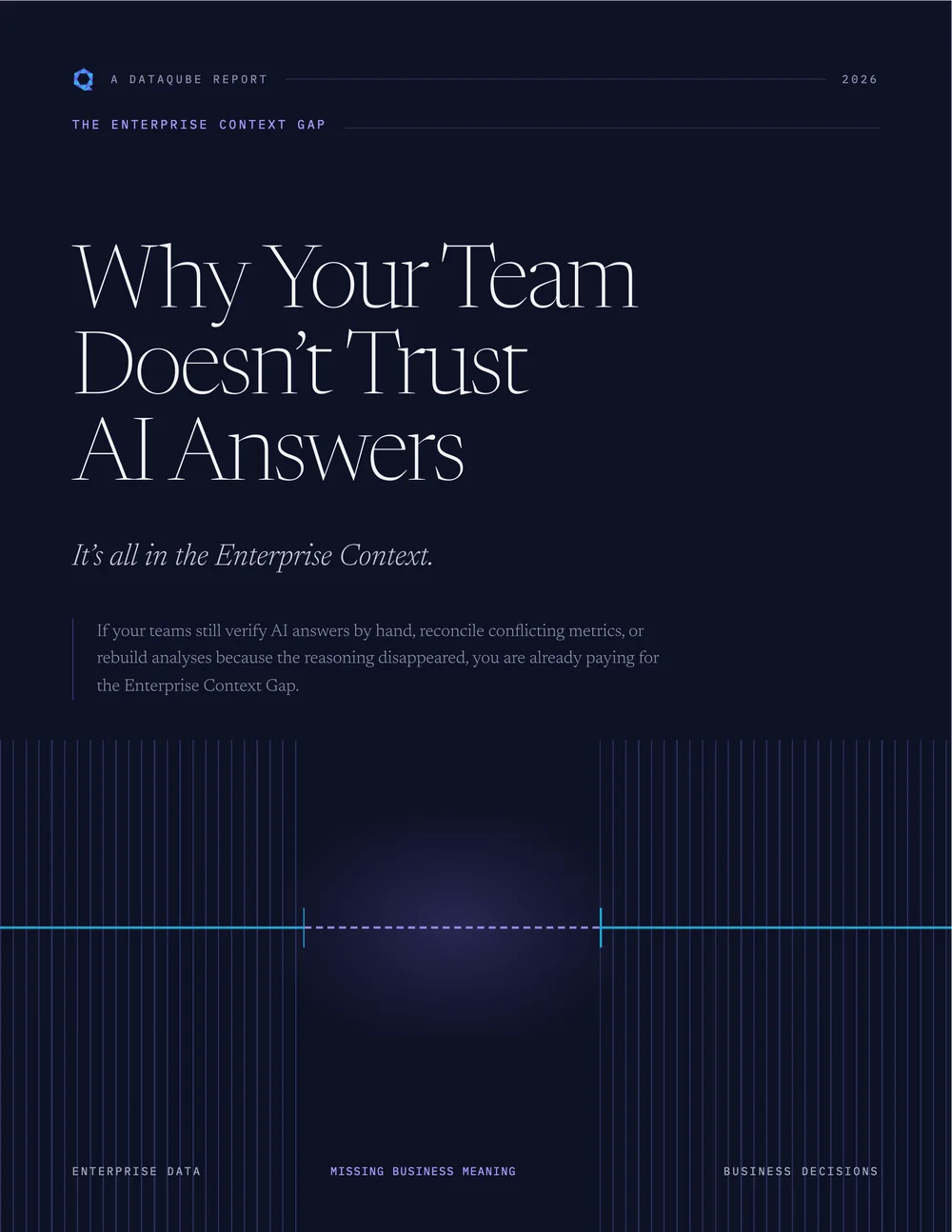
Why your team doesn't trust AI answers
A DataQube report on why enterprise AI has a trust problem, not an access problem — what the gap costs, and the five-stage maturity model for closing it.
- Five conclusions for data and AI leaders, with the evidence behind each
- The five-stage Enterprise Context Maturity Model, with a self-assessment
- Diagnostic questions after every chapter, and one company — Northwind Retail — followed end to end
- The Enterprise Context Layer: where context preservation sits in the stack
01Inside the report
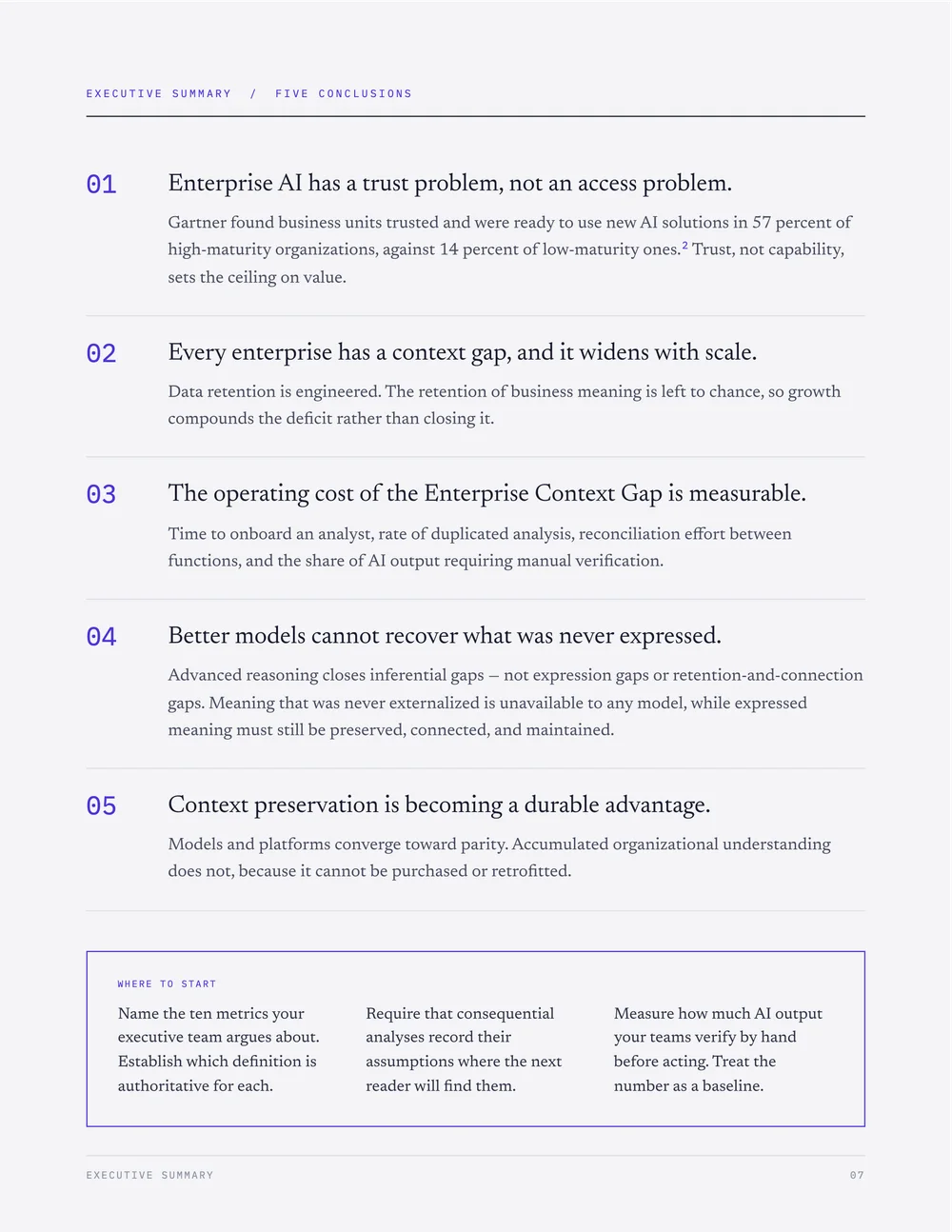
Five conclusions on the Enterprise Context Gap
The executive summary, condensed. Each conclusion is argued in full in the report, with the evidence behind it and a diagnostic question for your own organization.
- 01Enterprise AI has a trust problem, not an access problem.Business units trusted new AI in 57% of high-maturity organizations, against 14% of low-maturity ones. Trust, not capability, sets the ceiling on value.
- 02Every enterprise has a context gap, and it widens with scale.Data retention is engineered. The retention of business meaning is left to chance, so growth compounds the deficit rather than closing it.
- 03The operating cost of the Enterprise Context Gap is measurable.
- 04Better models cannot recover what was never expressed.
- 05Context preservation is becoming a durable advantage.
The evidence, the diagnostic questions and the Northwind Retail case behind each conclusion are in the report. Get the report
- 88%use AI in at least one business functionMcKinsey global survey, 2025 · cited in the report
- ~2 in 3have not begun scaling AI across the enterpriseMcKinsey global survey, 2025 · cited in the report
- 57% vs 14%business units that trust new AI — high- vs low-maturity organizationsGartner · cited in the report
Definition
What is the Enterprise Context Gap?
The distance between the enterprise information an organization has retained and the business meaning required to interpret, trust, and act on it — whether that meaning was never expressed, or was expressed but not preserved, connected, maintained, or made findable. The report names two origins: an expression gap, closed by changing how reasoning is recorded in the flow of work, and a retention-and-connection gap, closed by systems and governance.
- Isn't this what metadata and a data catalog already solve?
- No. Metadata describes information — owner, date, lineage, source system. Enterprise Context explains it: which definition applied when a figure was produced, what assumptions it rests on, why it changed and by whose decision. A report can be perfectly cataloged and still leave every decision-relevant question open.
- Won't better models close the gap on their own?
- Better reasoning closes inferential gaps, not expression gaps or retention-and-connection gaps. Meaning that was never externalized is unavailable to any model, and expressed meaning still has to be preserved, connected and maintained. That is why the report treats context as infrastructure rather than a model capability.
- Who is the report for, and how was it researched?
- Chief data officers, heads of analytics and BI, AI program leads, and the finance and operations leaders who sign off on what the business acts on. Numbered markers cite published third-party research listed in the endnotes; figures labelled conceptual are analytical models, not measurements; and Northwind Retail, the company followed through the report, is a composite drawn from patterns common across large enterprises.
02What's inside
Seven chapters, one company followed end to end
- 01The AI Adoption ParadoxMore data and better models — and decisions still wait for a human to interpret the answer.
- 02Defining the Enterprise Context GapThe distance between the information you keep and the meaning needed to act on it.
- 03What Enterprise Context Is Made OfDefinitions, assumptions, decision rationale, reasoning, exceptions, priorities, provenance.
- 04Why Context Is LostExpression gaps versus retention-and-connection gaps — and why they need different fixes.
- 05Why AI Alone Cannot Close the GapBetter reasoning closes inferential gaps — not meaning that was never written down.
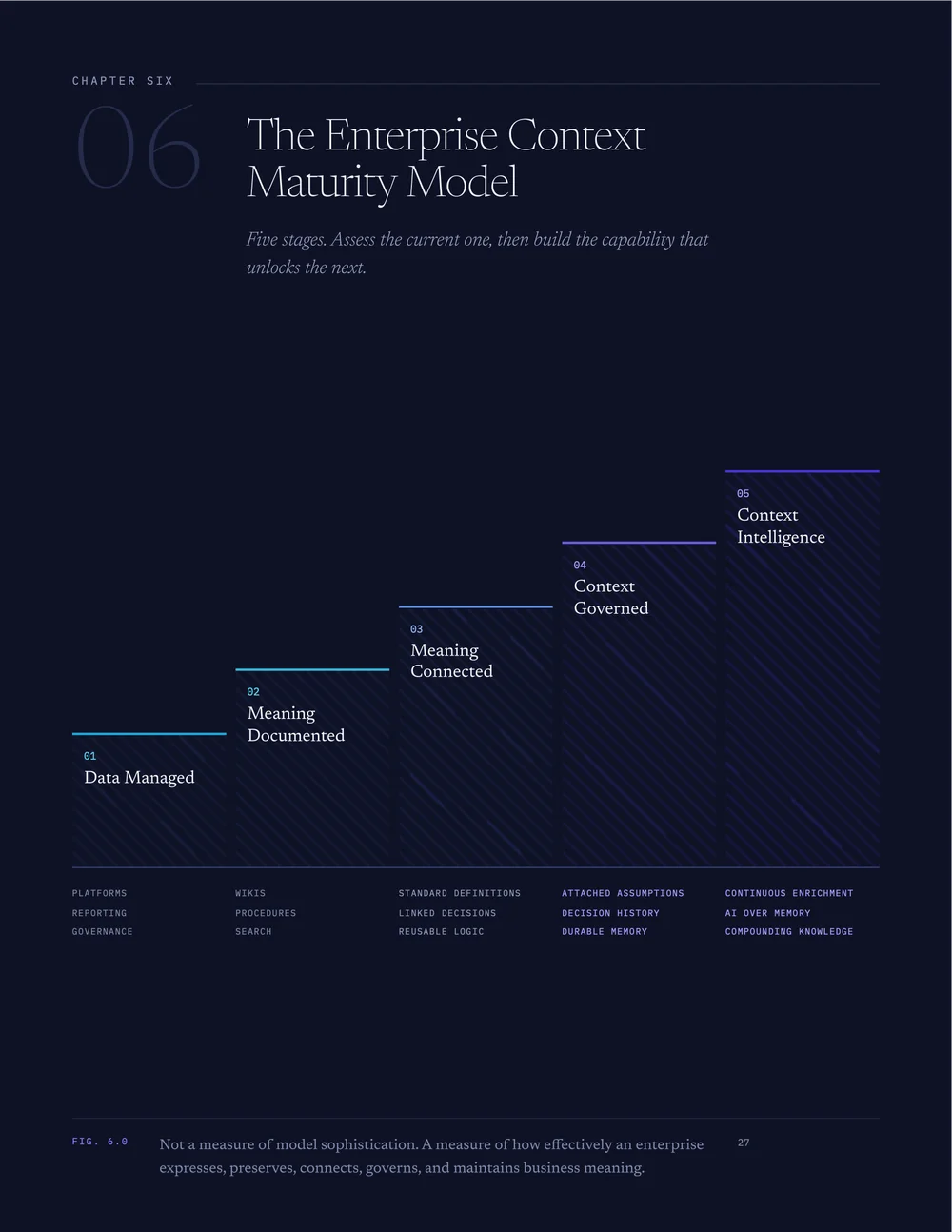
- 06The Enterprise Context Maturity ModelFive stages from Data Managed to Context Intelligence, with a self-assessment.
- 07The Context-First EnterpriseOperating characteristics of an organization that treats context as infrastructure.
- +The Enterprise Context LayerArchitecture: where context preservation sits in the stack, plus definitions and endnotes.
Who it's for
Chief data officers, heads of analytics and BI, AI program leads, and the finance and operations leaders who sign off on what the business acts on.
How to read it
Chapters 1–5 establish the problem and why better models alone won't resolve it. Chapter 6 is the maturity model and self-assessment. Chapter 7 describes the context-first enterprise. Northwind Retail, a composite company, is followed from chapter to chapter.
- Format
- PDF · 37 pages
- Language
- English
- Published
- 2026
Read the full report
Thirty-seven pages: the argument, the evidence, the maturity model and the self-assessment. Prefer to discuss it with us?